
For years, Surfrider has been sounding the alarm about what's happening to San Clemente's beaches.
Orange County Transportation Authority’s (OCTA) go-to strategy for protecting its rail line has been to drop boulders on the eroding beach. Surfrider has long opposed coastal armoring, but the scale of what's happened in recent years has brought a long-standing concern to a breaking point.
Surfrider commissioned Bob Battalio of Coastal Futures LLC, a coastal scientist with decades of experience in California shoreline dynamics, to assess the armoring and the alternatives. One report examines the revetment already built at Cyprus Shores, the other OCTA's proposed armoring at the adjacent San Clemente State Beach, an area OCTA calls "Area 4." Taken together, their findings are clear: the decisions made in the coming months will determine whether San Clemente's southern beaches survive.
What Happened at Cyprus Shores
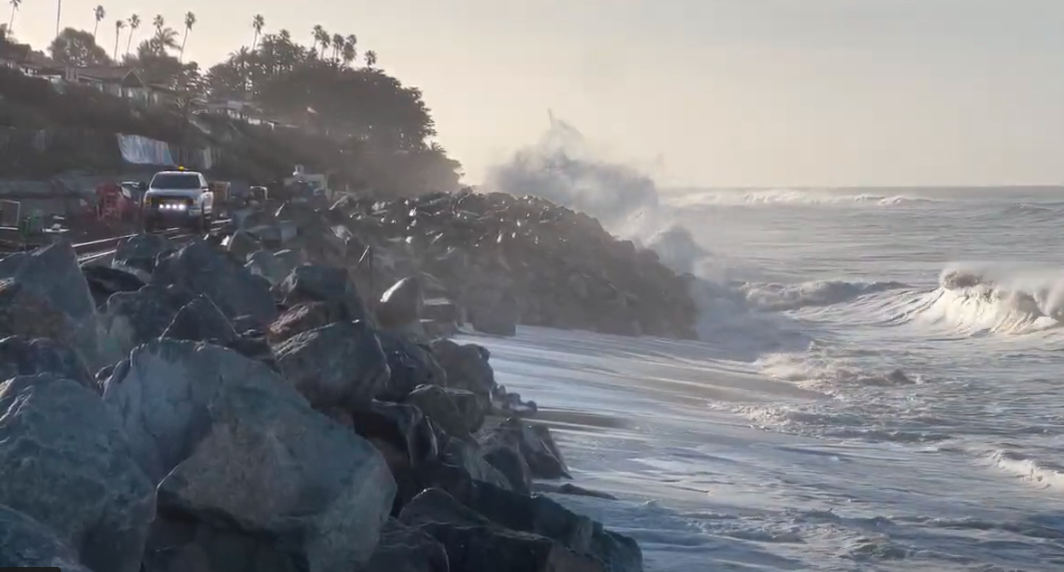
 Emergency armoring on the beach at Cyprus Shores
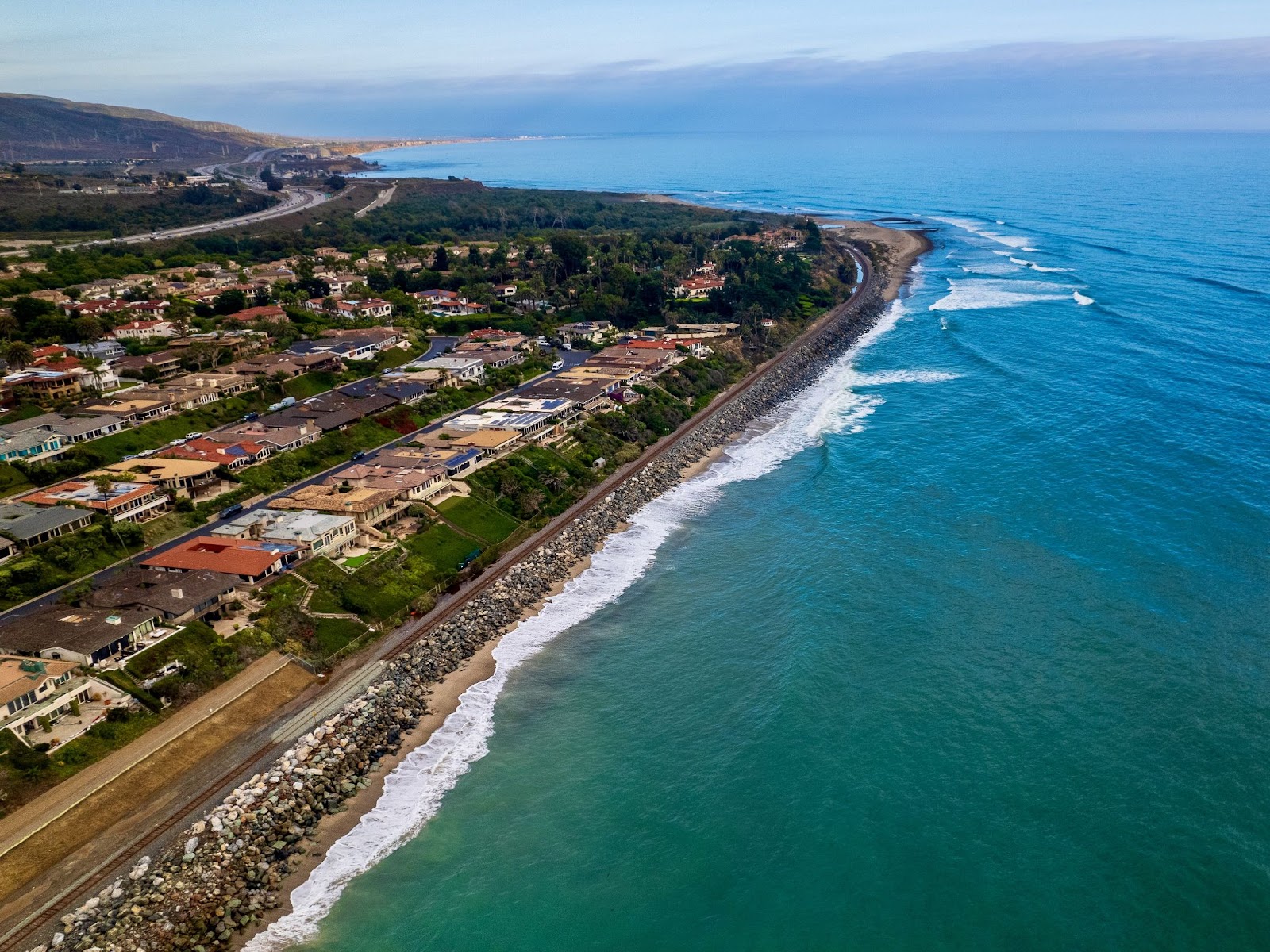
Cyprus Shores is a beachfront neighborhood at the southern end of San Clemente, just north of San Mateo (Cotton’s) Point and the world-famous Trestles surf breaks. The beach here once averaged 100 feet wide, but has narrowed substantially since 2014 due to reduced sand supply, shifting sand transport patterns, and large wave events. By 2021, accelerated erosion had cut the beach down to about 40 feet wide, and a landslide threatened the rail line. OCTA responded under emergency permit, dumping approximately 27,000 tons of riprap boulders along 1,250 feet of shoreline between 2021 and 2023.
The result: a once-walkable beach reduced to a pile of boulders. The seasonally averaged width is now under 10 feet, and each fall it narrows to zero. The dry beach that once connected the shore to Trestles is gone. Surfers, fishermen, and beachgoers who walked this stretch now face an impassable wall of rock.
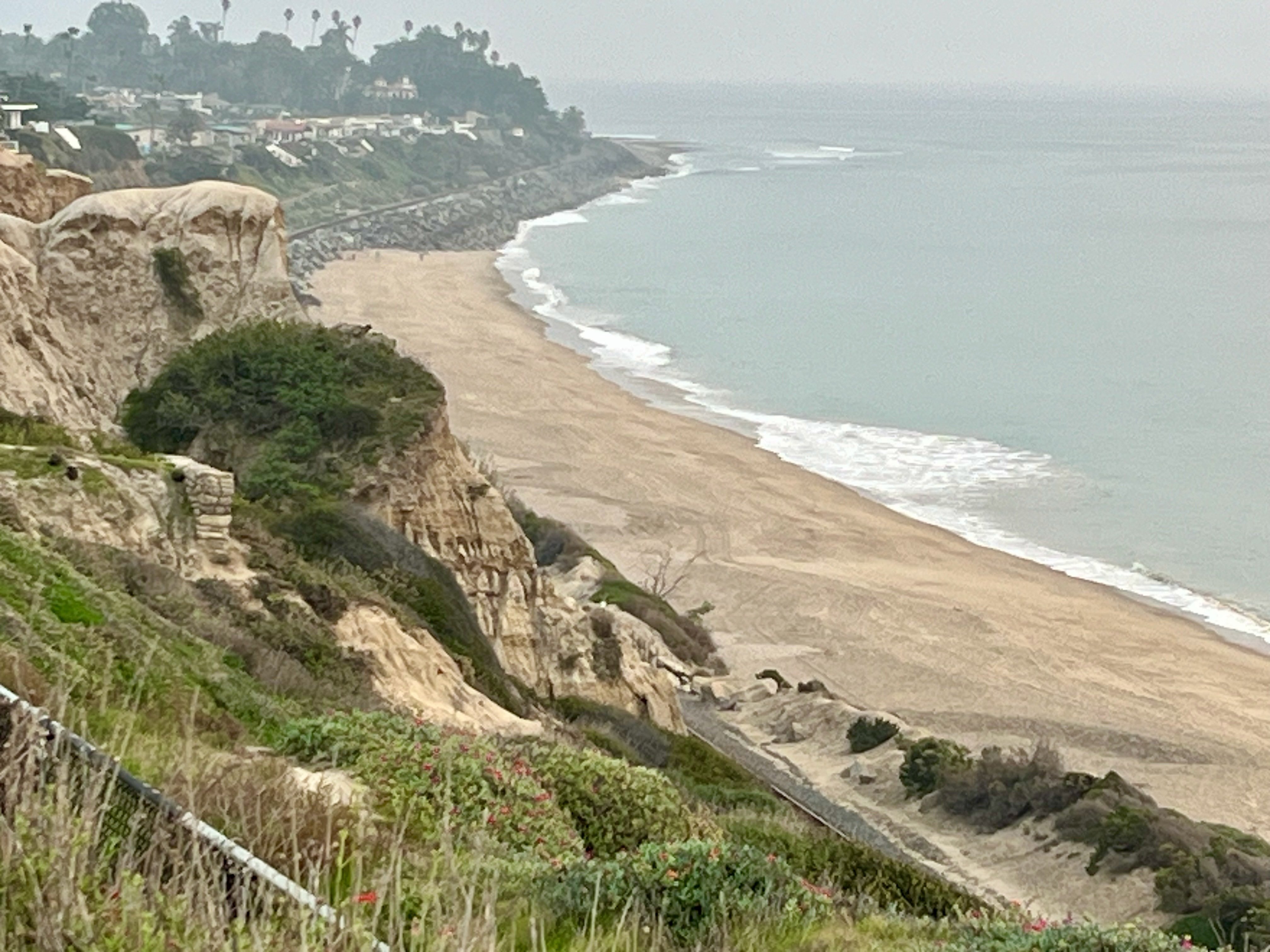 The beach ends where the emergency armoring begins (Dec 2025)
The Self-Defeating Cycle of Armoring
Battalio's most technically significant finding about the Cyprus Shores armoring is also the most counterintuitive: the rocks are actively making the problem worse.
Natural sandy beaches absorb wave energy by shaping themselves dynamically: sand moves, profiles shift, and the beach finds a natural equilibrium. Rock revetments don't do that. They reflect wave energy back out to sea, which scours the sandy seafloor in front of the structure, forming an underwater trough. As that trough deepens, larger waves break closer to the rocks and ultimately onto them, closing in on the railroad they were meant to shield. That concentrated energy scours deeper still, requiring more rock, which reflects more energy. It's a self-reinforcing cycle that the armor itself initiates.
Battalio has documented early signs of this pattern just south of Cyprus Shores, where a 2024 city survey recorded zero beach width and a deepening nearshore trough.
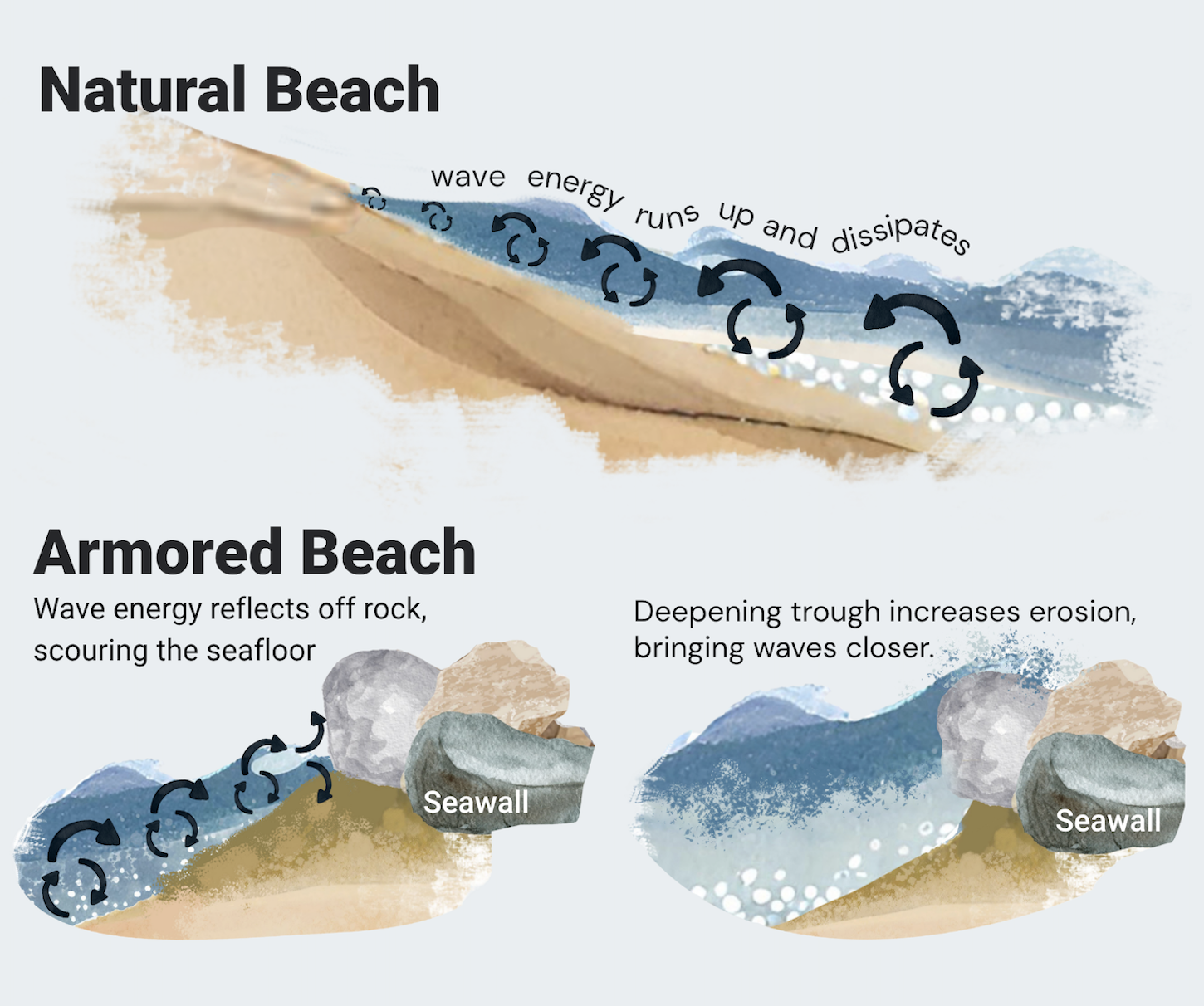 A rendering of how armoring results in beach scouring and sand loss
The Cost to Cottons
Cottons is the northernmost surf break in the Trestles complex, a long left that peels towards Cyprus Shores. It's also the second casualty of the revetment, after the beach itself.
Battalio documents that wave reflection off the revetment is already disrupting the wave at Cottons. Local surfers report that the wave, historically rideable through mid-tide, now only works at low tide. The revetment is also dangerous on its own. Surfers caught inside now face a wall of large, angular boulders where there used to be a sandy exit.
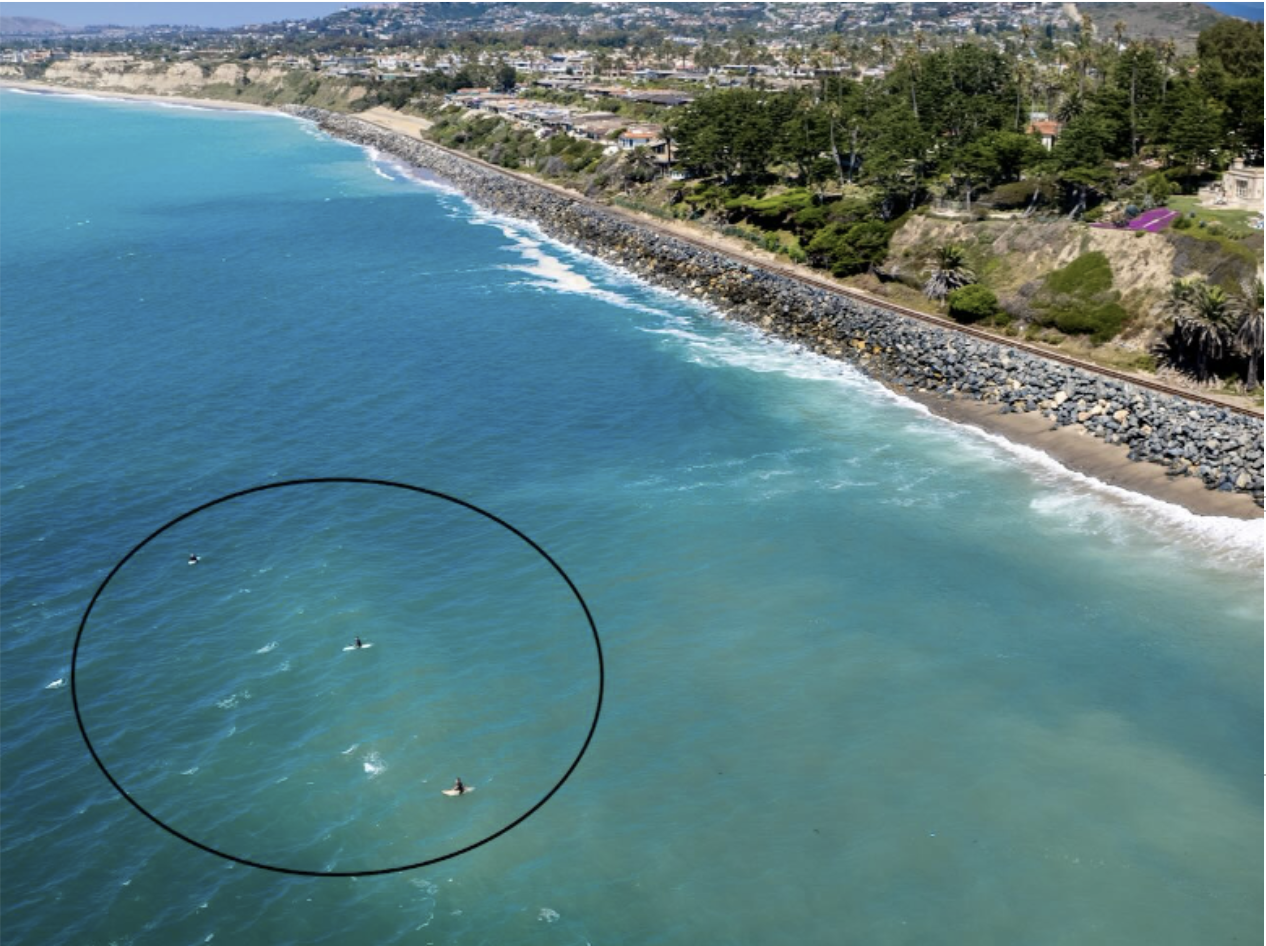 Surfers face deteriorating conditions at Cottons
The Threat at San Clemente State Beach
Just north of the Cyprus Shores revetment sits Area 4, the southern section of San Clemente State Beach. It includes the Calafia beach access and one of the few blufftop campgrounds on the Southern California coast. It's also where OCTA wants to extend its armoring.
What's proposed at Area 4 would extend the damage already done at Cyprus Shores, across an even longer stretch of shoreline. OCTA is seeking permits for roughly 2,000 feet of new armoring, including a 1,214-foot concrete seawall, or up to 33,000 tons of engineered revetment in its place. Battalio notes the real footprint could reach 4,000 feet once the stretches OCTA has flagged for repair "as needed" and additional new rock south of Area 4 are counted. OCTA has also proposed 270,000 cubic yards of sand to offset the impacts. Battalio credits that with helping temporarily, but concludes more than one placement would be needed to keep a beach there at all.
OCTA's proposal also calls for removing the existing vegetated, dune-like berm that currently sits between the railroad tracks and the beach. Although the berm is believed to cover legacy armoring, Battalio notes that it's functioning like a natural coastal bluff. As it erodes during storms, it delivers sand to the beach, partially replacing the natural bluff erosion process that the railway itself has interrupted for decades. Paving it over with concrete or rock would eliminate that function permanently.
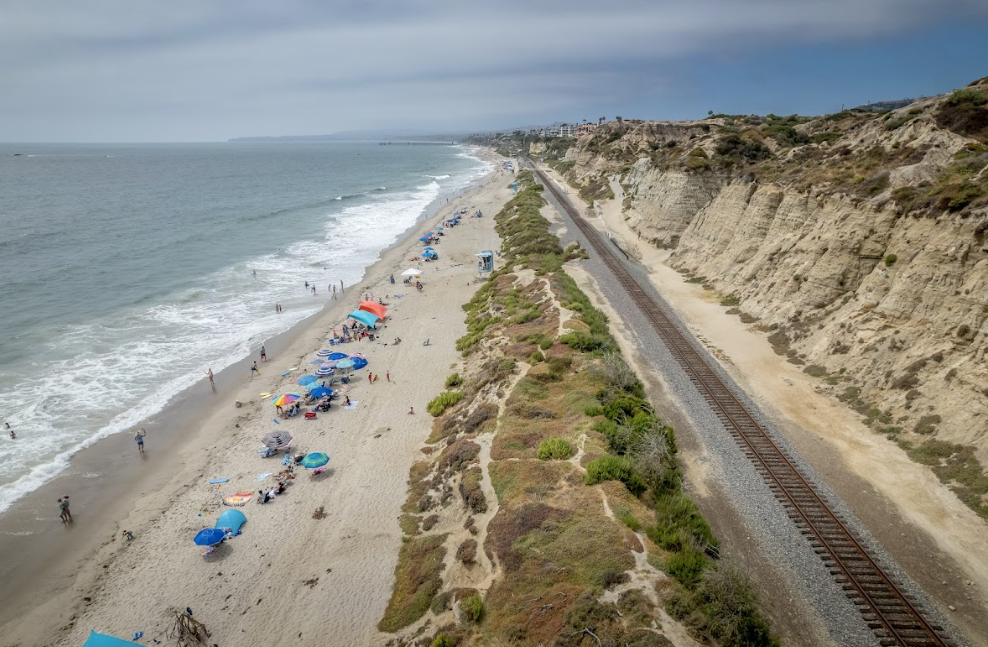 A portion of the Area 4 vegetated berm
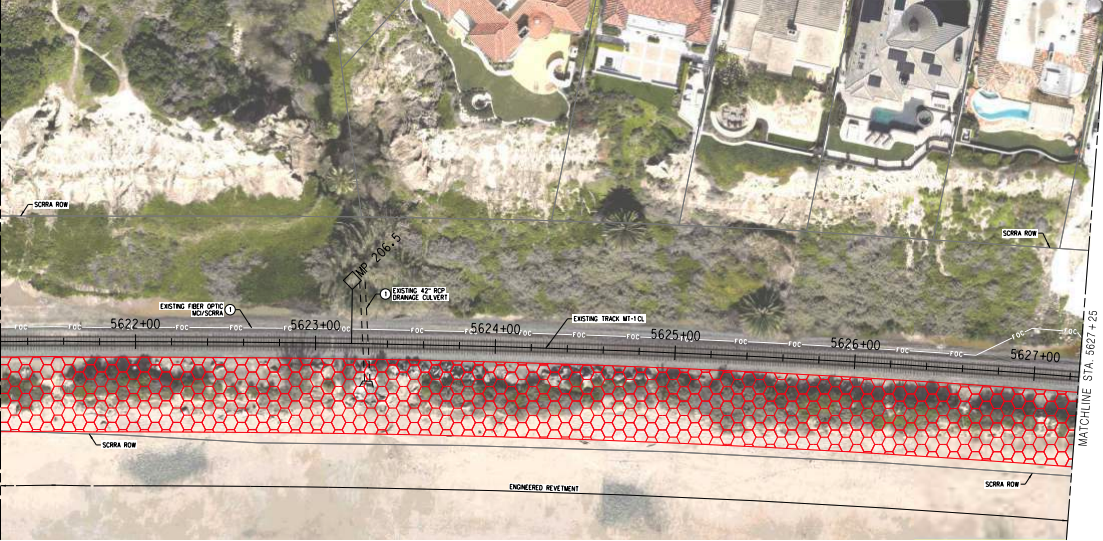 OCTA proposes to remove the berm and replace with boulders (Source: OCTA Emergency Application)
A Multiplying Threat
Sea level rise adds urgency to all of this.
Based on California's Sea Level Rise Guidance projections, flood conditions that are rare today will become routine within a generation. And the armoring meant to hold the line in the meantime is likely shortening that window.
The rail line at Cyprus Shores already sits at the edge of what flood models consider a worst-case scenario. And on an armored shoreline with little or no beach in front of it, the math gets worse fast. Battalio's research shows that hard structures concentrate and redirect wave energy upward rather than dissipating it across a wide beach face, multiplying the flood threat three to five times faster than sea level rise alone.
In other words, time is running out.
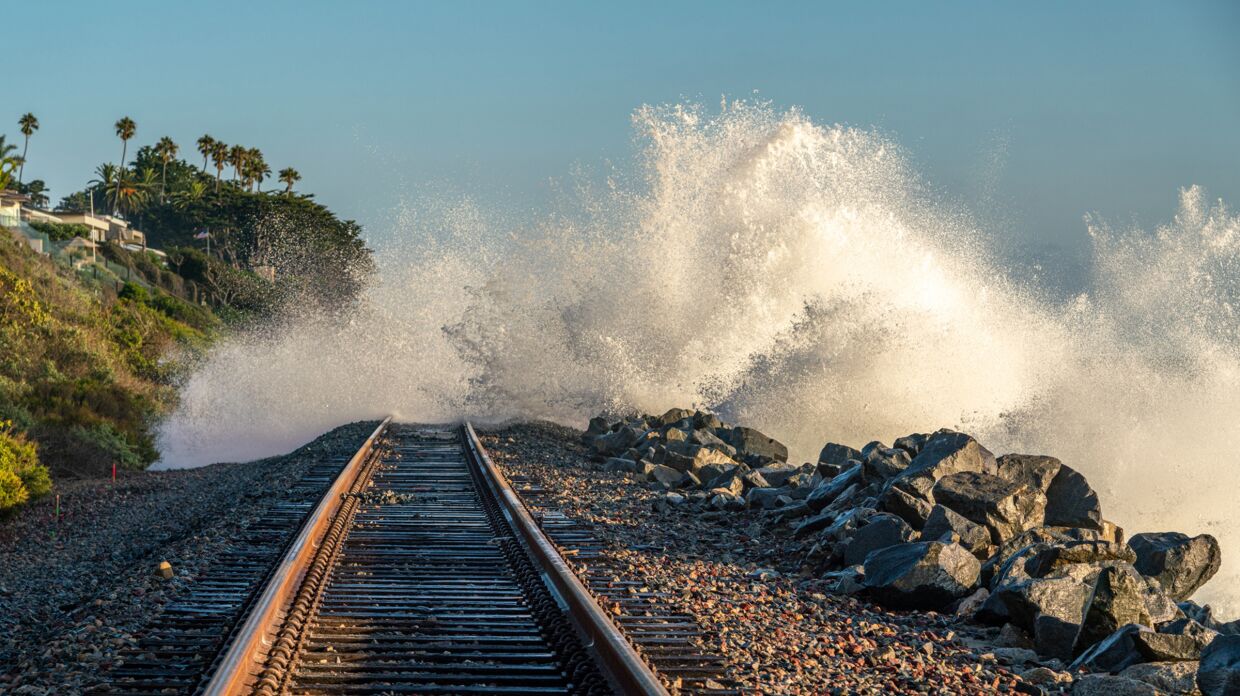 Waves overtop the railroad below Cyprus Shores
What’s a Beach Worth?
At least $96 million.
That's the price tag for past and proposed beach loss at Cyprus Shores and Area 4 combined. Battalio used a beach valuation methodology developed with California Coastal Commission staff, updated for construction cost inflation, to arrive at that figure. And the real number is likely much higher — if the actual armored shoreline at Area 4 reaches the 4,000 feet Battalio identifies as possible, the total liability could approach $200 million or more.
To put that in perspective: from Cyprus Shores through Area 4, over a mile of San Clemente's shoreline has been armored or is proposed for armoring. OCTA has yet to be held accountable for any of the beach loss that the boulders have contributed to, both in physical footprint of the rocks or subsequent erosion.
Ultimately, no amount of money replaces what's being lost. A natural beach's recreational, ecological, and economic value can't be replicated anywhere else, or bought back once it's gone.
There Is a Better Way
Battalio's reports also offer a path forward, one Surfrider believes is both technically sound and more consistent with the Coastal Act.
The most immediate recommendation is straightforward: maintain a beach in front of the railroad. A healthy beach is itself the most effective buffer against wave energy, far better than rock at dissipating the forces that threaten the tracks. Sand placement, coordinated with the ongoing US Army Corps-City of San Clemente beach replenishment program, is a starting point. Sand placement alone, however, becomes increasingly costly and difficult to maintain as sea levels rise. Battalio notes that sustaining a beach wider than its natural equilibrium requires ever more frequent replenishment cycles. But pairing sand with nature-based approaches can add resilience by helping sand remain on the beach longer than it would on its own.
At Area 4 specifically, Battalio identifies options that haven't been seriously pursued: restoring the drainage arroyos that the rail corridor has blocked for decades, allowing bluff sediment to reach the beach again; and actively rebuilding the vegetated dune-like berm using bluff material that has accumulated on the landward side of the tracks. Both approaches restore natural processes that helped maintain beach width before the railroad got in the way.
A native dune system, established seaward of the existing berm, could take this natural protection a step further. Battalio calculates a minimum beach width of 150 feet is required for a vegetated dune system to be viable, and Area 4 beaches have recently averaged right at that threshold. Additional sand placement could push it over that line. Once established, the dunes would act as a first line of defense against wave runup, with the existing vegetated berm as the final backstop. Nature's own layered coastal protection.
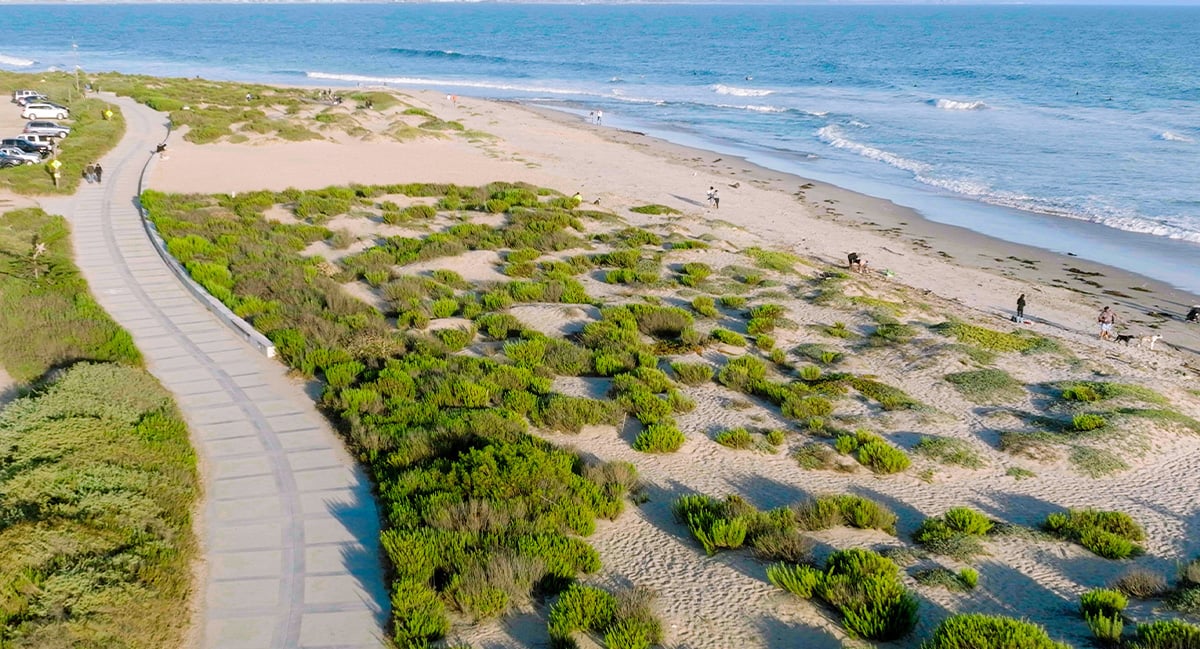 An example of a restored native dune system in Ventura, CA
His conclusion on Area 4 is direct: with the right combination of softer strategies, the proposed armoring there "may not be needed in the near term." That recommendation comes from an independent coastal scientist, not Surfrider.
And in both reports, Battalio's final recommendation is the same: assess relocation of the railway away from the shore as soon as practicable. A rail corridor can be moved. A beach cannot.
Where Things Stand
OCTA and the California Coastal Commission are currently negotiating the future of both sites. At Cyprus Shores, the question is how OCTA will formally mitigate the damage already done. Battalio recommends assessing whether the revetment footprint can be reduced. Surfrider supports this as a minimum first step, and continues to call for removal of the revetment and restoration of the beach. At Area 4, the question is how much armoring, if any, will be permitted, and whether OCTA will be required to pursue alternatives first.
Battalio's reports make the stakes clear. What happened at Cyprus Shores — a public beach reduced to boulders, a world-class surf break degraded, a shoreline locked into an escalating cycle of armoring and erosion — cannot be allowed to repeat itself at San Clemente State Beach.
The beach belongs to all of us. And right now, the decisions being made by OCTA and the Coastal Commission will determine whether it's still there for the next generation of surfers, swimmers, and families who love this stretch of coast.
 Mitch served in various volunteer leadership positions with the San Diego Chapter before being hired on as Chapter Manager in 2018. In 2022, he transitioned to the chapter’s policy role. In 2025, he's broadened his scope as California's Senior Policy Coordinator.